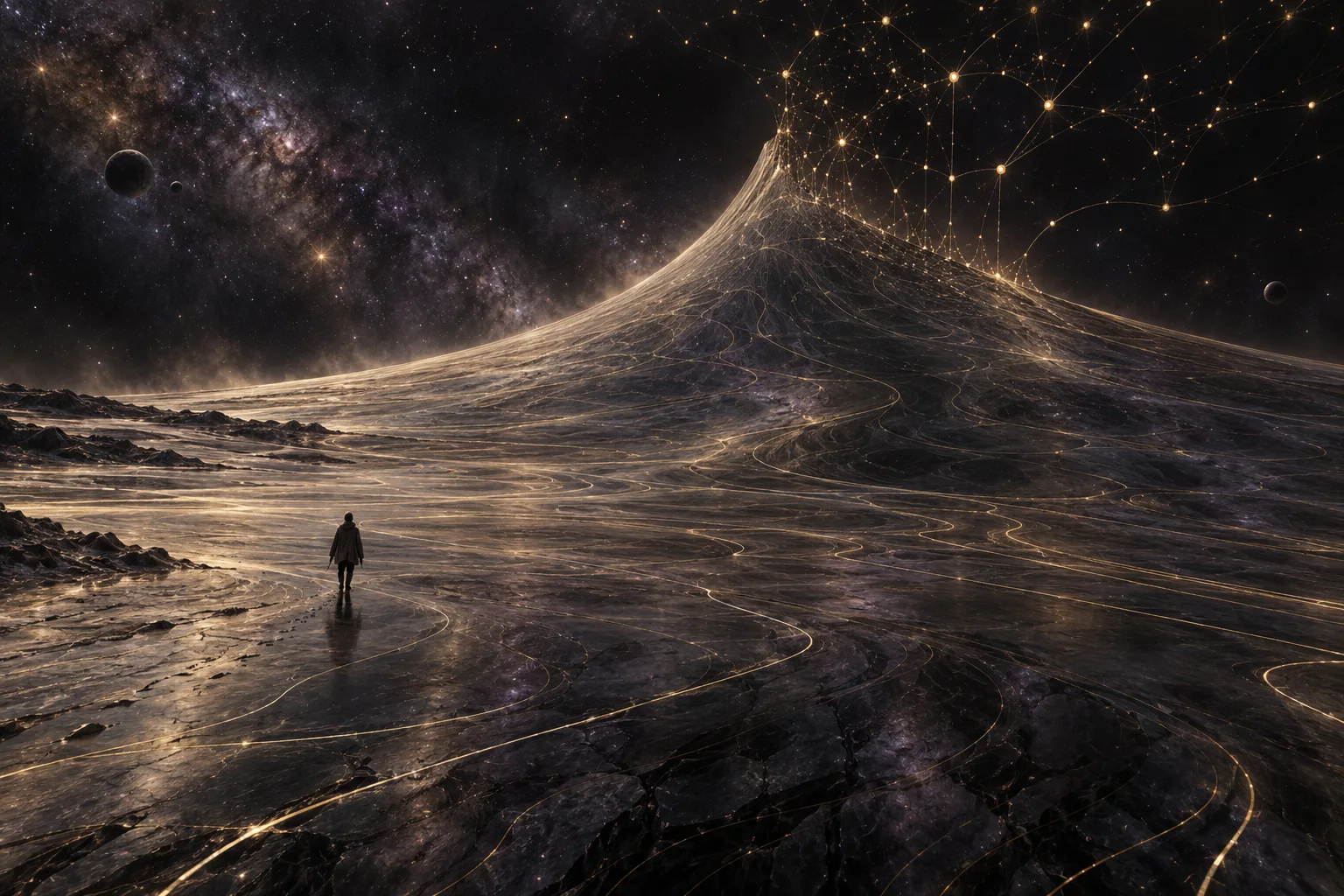
When we hear the word space, we tend to imagine somewhere.
The room around us. The distance between Earth and the Moon. The vast darkness between galaxies.
Space is where things are.
But modern physics and mathematics use the word in a much stranger way. They have discovered that you can build spaces not just from places, but from possibilities.
And if we follow that idea far enough, it takes us on a peculiar journey.
We begin with the space outside us.
We end with the space inside our heads.
And somewhere along the way, it becomes possible that these are different views of something deeper.
1. The Space We Live In
Start with the Earth.
From where you are standing, the ground appears more or less flat. You can walk forward, backward, left or right. But zoom far enough out and you discover that this apparently flat landscape is part of the curved surface of a planet.
Physics does something similar with spacetime.
Einstein's general relativity describes the universe as a smooth landscape. Locally, things behave predictably enough that we can talk about positions, directions and movement. Across enormous distances, however, the landscape itself can curve and distort.
Mathematicians call this kind of object a smooth manifold.
The terminology sounds formidable. The intuition isn't.
Imagine an ant walking across a gigantic rubber sheet. From the ant's perspective, its immediate surroundings look reasonably flat. Seen from outside, the sheet might be bent, stretched or folded.
Our spacetime is vastly more complicated, but the basic idea is similar.
And at this stage, the points in our landscape have an intuitive meaning.
A point means:
Reality here.
Move to another point and you have changed location.
So far, so familiar.
Then physics introduces a very different kind of landscape.
2. A Space Made From Possible Realities
A vacuum in modern physics doesn't simply mean an empty box with everything removed from it.
Even apparently empty space has an underlying physical state.
And, depending on the theory, that underlying state may be capable of settling into different stable arrangements.
Imagine an enormous mountainous landscape.
Drop a ball onto it and the ball rolls downhill until it settles into a valley.
There might be many valleys.
Each represents a different stable arrangement.
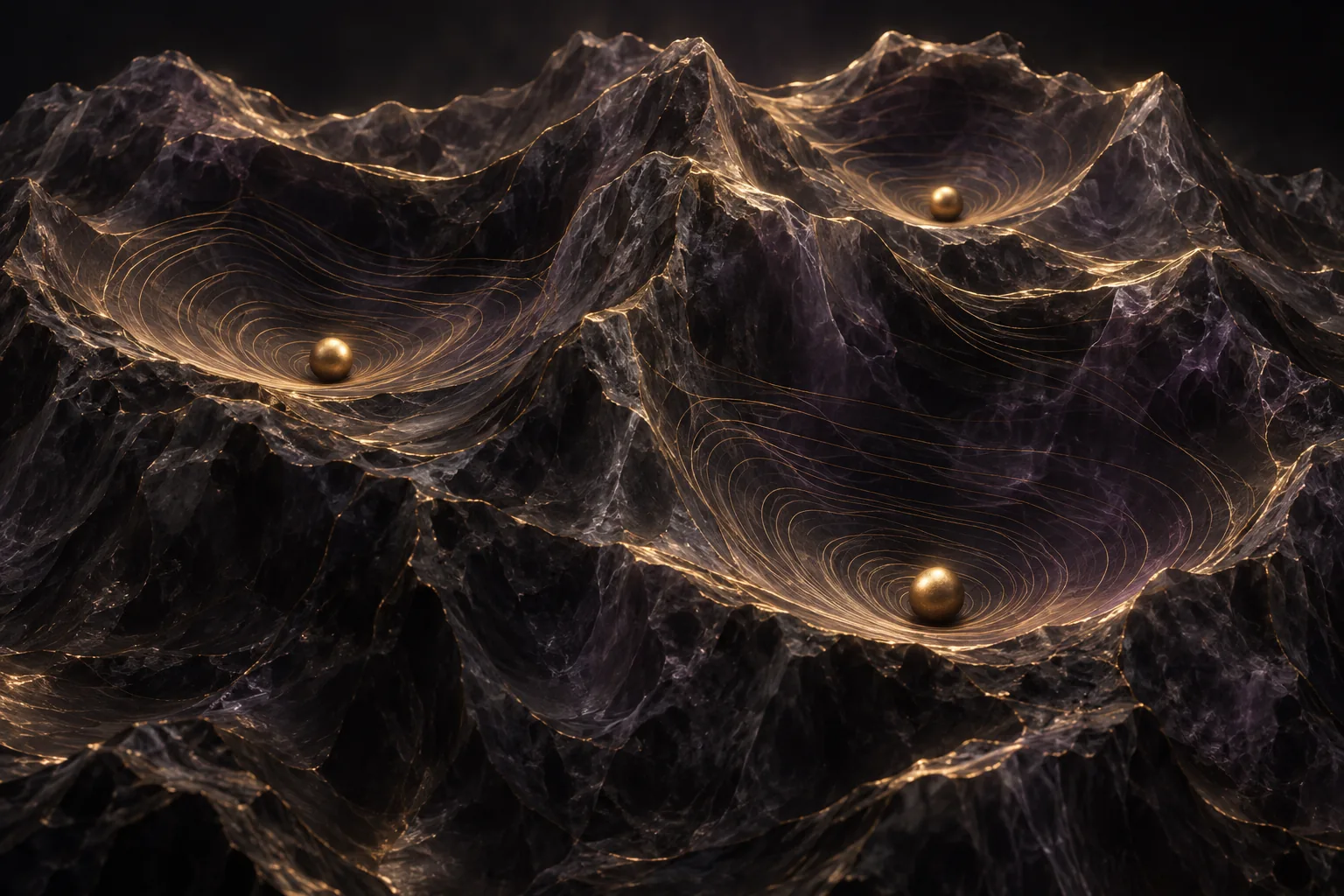
The startling part is that these valleys don't represent different places.
They represent different ways reality could be configured.
We have changed what our map means.
On our original map:
A point = reality here.
On this new map:
A point = reality configured this way.
This is the basic intuition behind what physicists call a space of vacua.
The geography is no longer geography in the ordinary sense. You couldn't travel east for twenty miles and arrive at another vacuum.
Instead, we have taken different physical possibilities and arranged them into a landscape according to their relationships.
Space has become something more abstract.
It has become a way of organising possibility.
And once you have made that conceptual jump, a much bigger one becomes possible.
3. Why Stop at One Set of Rules?
A space of vacua still begins with some underlying theoretical machinery.
We have some rules, and we ask:
What different stable realities do these rules permit?
Stephen Wolfram's idea of the Ruliad starts from a much more radical direction.
Don't choose the rules.
Include them all.
Imagine every possible computational rule.
Every possible starting point for those rules.
Every possible sequence those computations could produce.
Every branch.
Every history.
Every possible computation.
Instead of exploring all the worlds allowed by one system of rules, we have expanded the landscape towards the totality of computational possibility.
The progression is extraordinary.
First we asked:
Where can something be?
Then:
How could reality be configured?
And now:
What can possibly be generated?
The landscape has exploded.
And yet something important has remained constant.
We are still turning difference into geometry.
Things that are closely related can be thought of as nearby.
Things requiring substantial transformations to get from one to another are farther apart.
Paths become possible.
Regions emerge.
Instead of geography describing the relationship between London and New York, we now have a kind of geography describing relationships between possibilities.
And that brings us somewhere unexpected.
Because there is another landscape we navigate constantly.
4. The Geography Inside Your Head
Think about the word tree.
Tree leads naturally to branch.
Branch can lead to family tree.
Family tree can lead to ancestry.
Ancestry can lead to evolution.
Evolution can lead to natural selection.
Natural selection can lead to algorithms.
Algorithms can lead to computation.
Nothing travelled through physical space during that journey.
And yet you went somewhere.
Some concepts seem close together.
Others are distant.
Ideas form clusters. There are bridges between subjects. Some ideas can only be understood after other concepts have been reached first.
Occasionally someone makes a connection between two regions that had previously seemed unrelated, and an entirely new field of thought opens up.
We routinely describe this spatially without noticing what we're doing.
We talk about fields of knowledge.
Domains.
Conceptual distance.
Lines of thought.
Connections between ideas.
We explore a subject.
We arrive at conclusions.
We get lost in thought.
This is conceptual space.
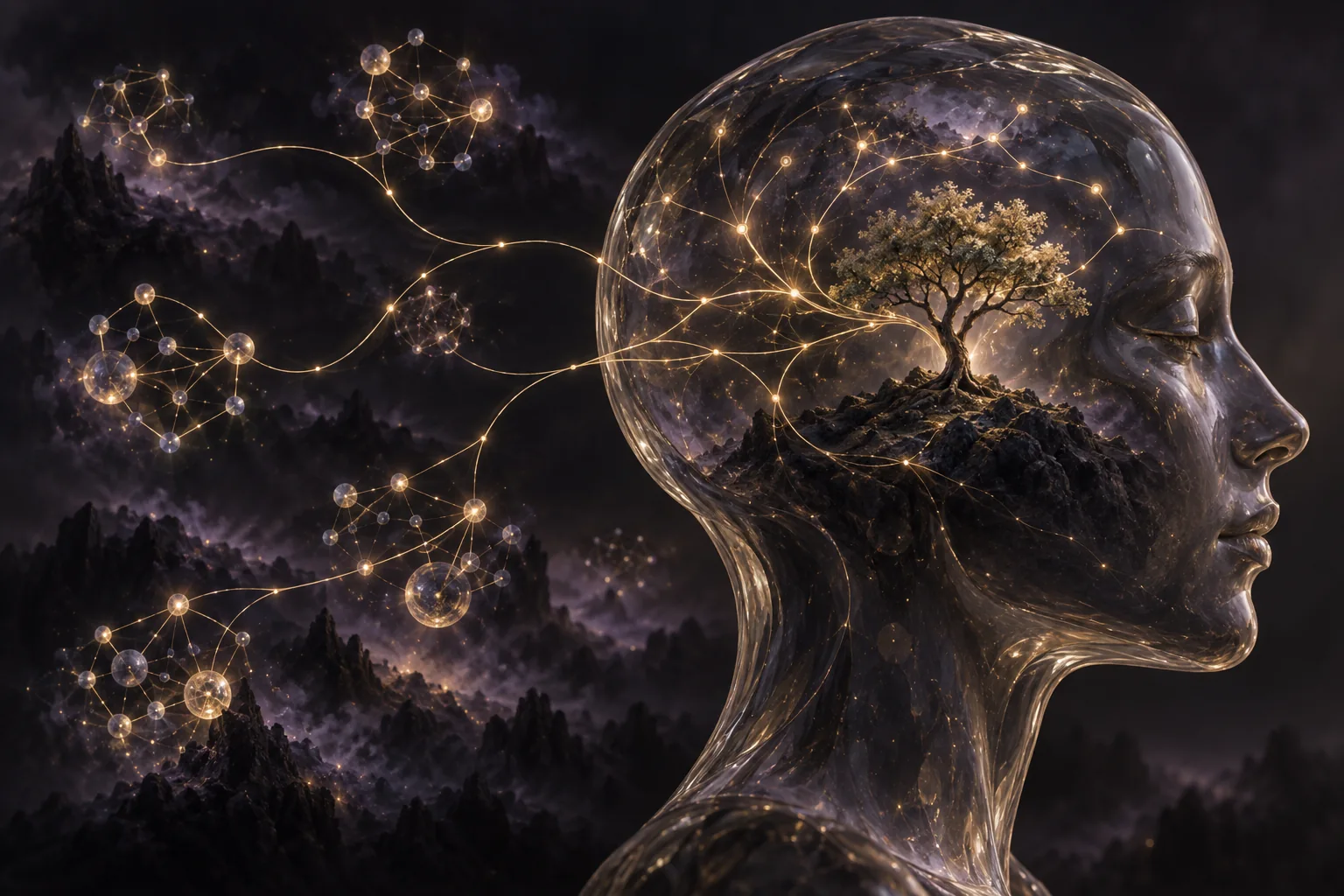
Or, when we're particularly interested in relationships between meanings, semantic space.
And it produces another version of our strange map.
In physical space, distance represents difference in location.
In the space of physical possibilities, distance represents difference in configuration.
In rulial space, it represents difference in computational rules and processes.
In semantic space, it represents difference in meaning.
At first glance these appear to be increasingly abstract versions of the same trick.
But perhaps there is another way to look at it.
5. Two Ways Into the Same Space
Suppose semantic space and computational space aren't entirely separate landscapes.
Suppose they are different ways of approaching the same underlying structure of possibility.
The computational approach is constructive.
It asks:
What operations get us from here to there?
Begin with something. Apply a rule. Apply another rule. Follow the consequences. Branch when alternatives arise.
Eventually you reach some particular possibility.
Semantic exploration encounters the process from almost the opposite direction.
It asks:
What is here? What does it mean? What is it connected to? Where can I go next?
One perspective describes how the paths are generated.
The other describes what it is like to navigate the resulting territory.
Think of a mountain.
A geologist can explain the mountain through the processes that constructed it: tectonic movement, volcanic activity, erosion, ice and water.
A walker encounters that same mountain differently: valleys, ridges, obstacles, connections, destinations.
They aren't describing two mountains.
They are approaching the same structure from different directions.
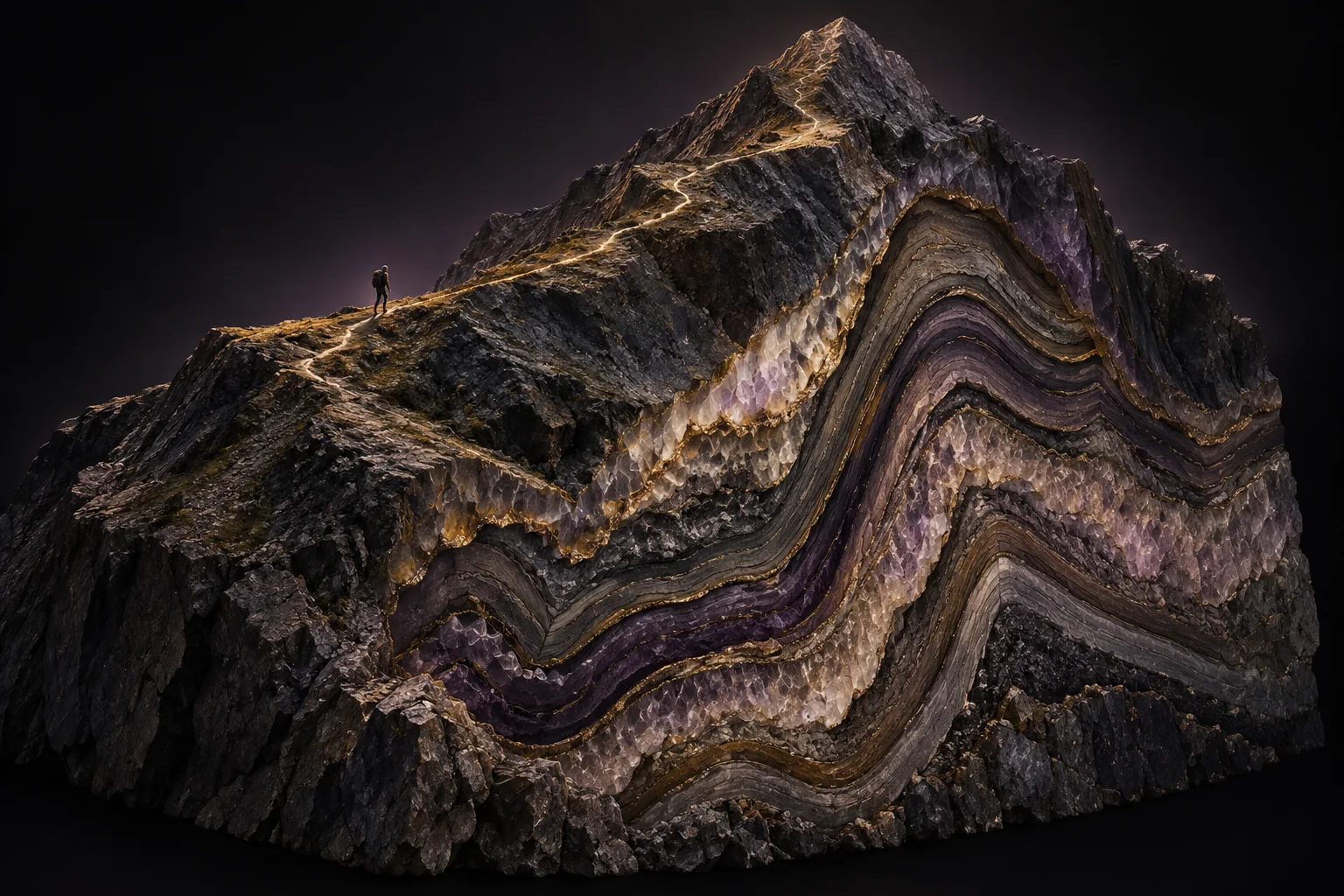
Perhaps something similar is happening here.
Computation describes how the territory is constructed.
Semantics describes what it is like to explore it.
6. What, Then, Is an Idea?
This creates an uncomfortable question.
When someone has a genuinely new idea, what exactly has happened?
Our normal language says they created it.
And clearly something constructive has occurred. Their brain has undergone a sequence of physical and informational processes that produced a state it had not previously occupied.
But subjectively, discovery often feels different.
You follow something.
You notice a connection.
Something clicks.
And suddenly you see it.
Mathematics provides particularly striking examples.
A mathematician can spend years searching for something and then discover a relationship whose consequences are not theirs to choose.
Once they reach it, they cannot simply decide that it works differently.
The territory seems to push back.
This doesn't prove that ideas exist independently somewhere waiting for minds to find them. That is a much larger philosophical claim.
But it does expose an interesting ambiguity in the word discovery.
Perhaps creating a new idea and discovering one aren't necessarily opposites.
They may describe the same event from our two perspectives.
From the computational direction, a path has been constructed that reaches a new state.
From the semantic direction, an explorer has arrived somewhere new.
Construction describes the journey.
Discovery describes the arrival.
7. The Journey Folds Back on Itself
We began outside ourselves.
With spacetime.
With positions, distances and the physical landscape of the universe.
Then we encountered spaces whose points weren't places at all, but possible configurations of reality.
From there we moved into computational possibility: landscapes constructed from rules, transformations and everything those processes could generate.
And eventually we found ourselves back inside the mind.
Except now thought itself looked different.
Perhaps conceptual space isn't merely a poetic metaphor for the contents of our heads.
Perhaps minds are systems capable of navigating an extraordinarily structured landscape of possibility.
And perhaps computation and meaning give us two complementary views of that landscape.
One from the machinery that makes movement possible.
The other from the perspective of something doing the exploring.
That leaves a question rather than an answer.
When you have an idea that nobody appears to have had before, what exactly just happened?
Did you create somewhere new?
Or did you become the first thing in the universe to find a path there?
We set out looking at the space in which reality exists.
We ended up asking whether reality itself exists within a space of possibilities.