
01 / Reality
The world is
already shaped.
A surface can support your weight or give way beneath it. Your expectation matters to what you attempt. It does not, by itself, decide what the surface can bear.
This position begins there: reality exists independently of any particular mind. It contains differences, relationships and constraints that our descriptions can discover, miss or misrepresent.
Much of what we call a thing is a pattern continuing through change. A river persists while its water passes through. A body remains recognisable while exchanging matter and energy with its surroundings.

The water changes. The river remains recognisable.
We do not need to know reality’s final substance to investigate the relationships that make these patterns possible. What ultimately grounds those relationships remains an open question.
Explore the territory: Life02 / Meaning
Life makes some
differences matter.
For a living system, the world has stakes. Some changes help it continue. Others damage the organisation on which its continuation depends.
A boundary allows that organisation to be maintained. It creates an inside whose conditions can differ from those outside, while exchange across the boundary keeps the system alive.
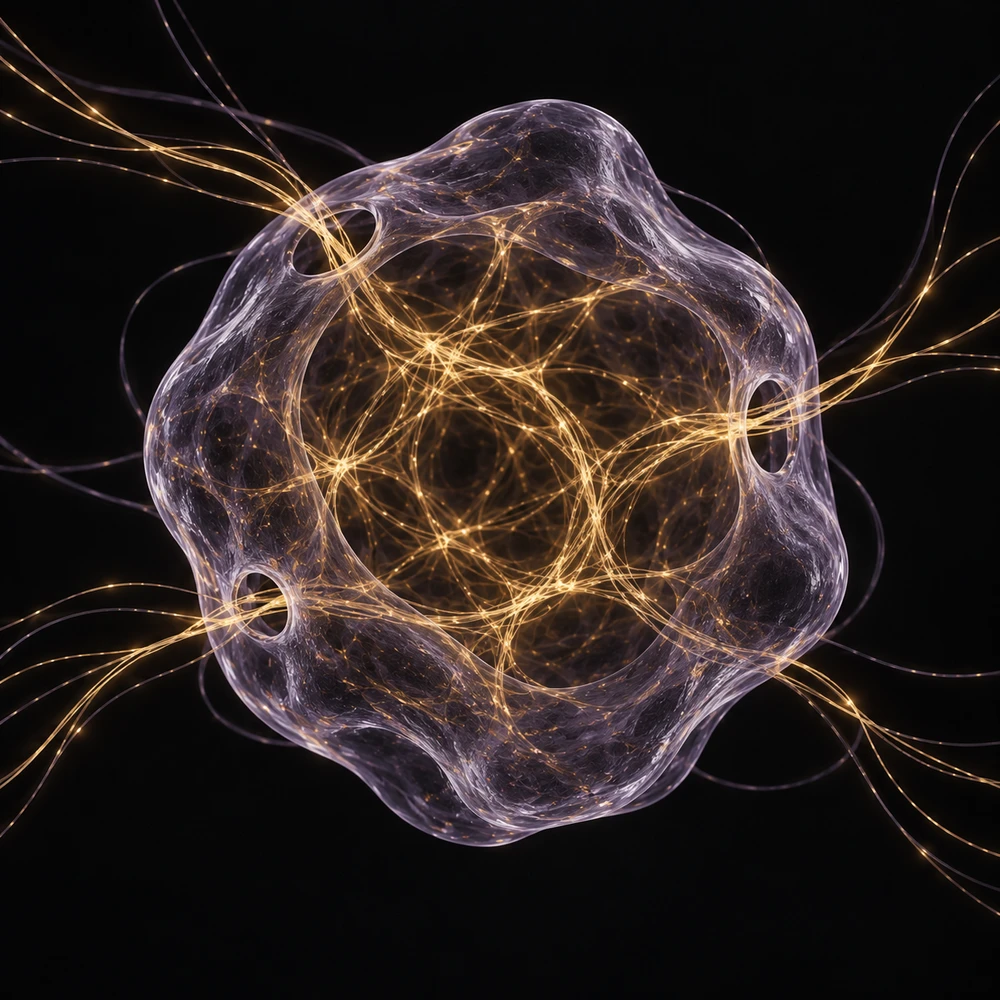
What lies inside depends on what passes through.
The proposal here is that meaning begins when a difference bears on the continuation of such a system and becomes incorporated into the way it regulates itself. At this level, meaning does not require words or a conscious interpretation.
It belongs to a relationship. The same substance may nourish one organism and poison another. What matters depends on the receiver, but the consequences cannot simply be wished away.
Meaning is relative to a life.
That does not make it arbitrary.
A distinction that still needs testing
Calling this the beginning of meaning is a theoretical proposal. It must explain what separates meaningful regulation from mere causal impact: a rock is also changed by its surroundings. The test is whether the account identifies an organised use of a difference, including ways that use can succeed or fail.
03 / Compression
We need a world
we can use.
You do not need the entire history of a door to open it. You need to recognise a handle, a direction of movement, perhaps the fact that it is locked.
A finite mind has limited time, attention, memory and energy. It preserves some distinctions and lets others recede. An overwhelming world becomes available through a smaller understanding.
This is the work of compression. A word gathers many encounters. A skill preserves something learned through practice. A model carries relationships that allow us to anticipate what has not happened yet.
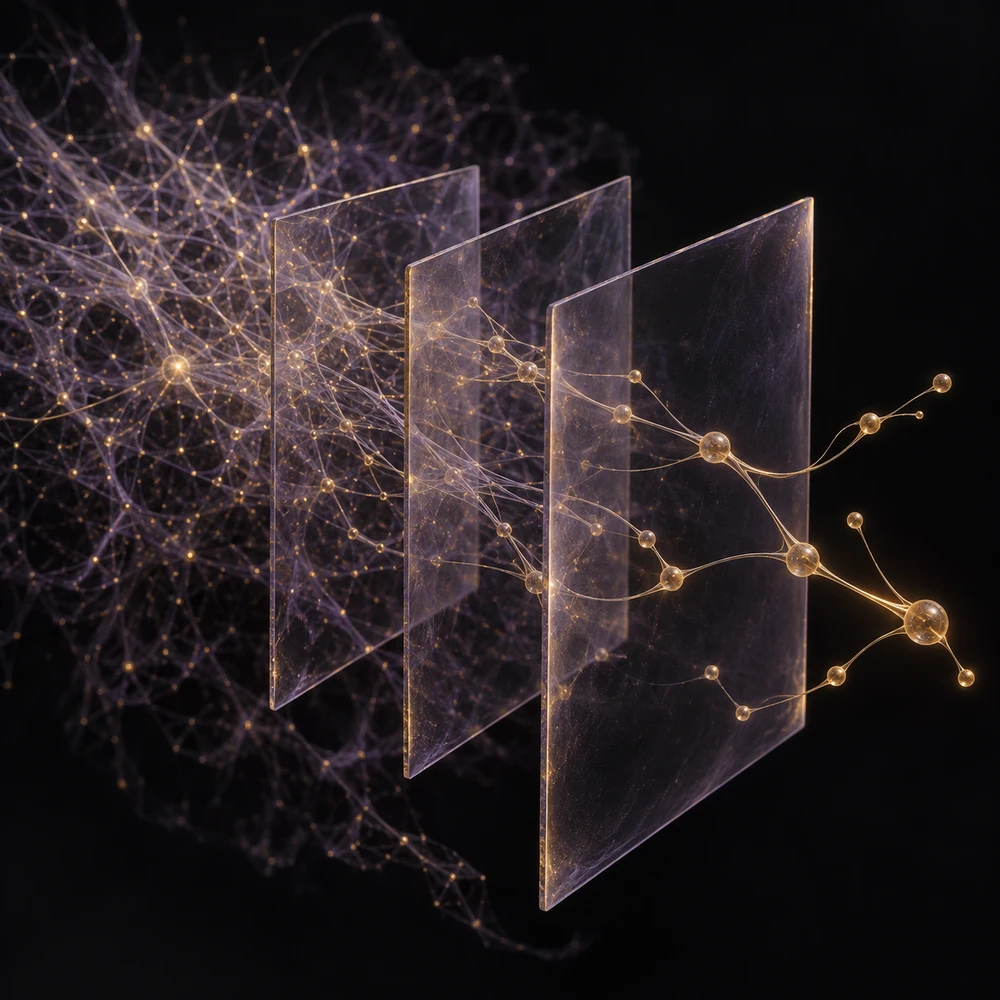
Every useful understanding leaves something out.
Its quality depends on what survives that narrowing. A map may guide a journey while saying little about the place itself. A story may bind a group together while getting important facts wrong. Usefulness has more than one dimension.
Compression describes how a system preserves selected structure. It does not, by itself, explain why there is a world to preserve.
Explore the territory: Language04 / Knowledge
The world
answers back.
You expect the door to open. It does not. Something in your understanding now needs attention.
Knowledge develops when consequences can change the model that anticipated them. An explanation earns trust by surviving relevant tests, making reliable predictions and remaining open to revision.
Critical thinking means allowing evidence and experience to correct your understanding. Sometimes that means becoming less certain. Sometimes it means discovering that the categories in which you asked the question were too narrow.
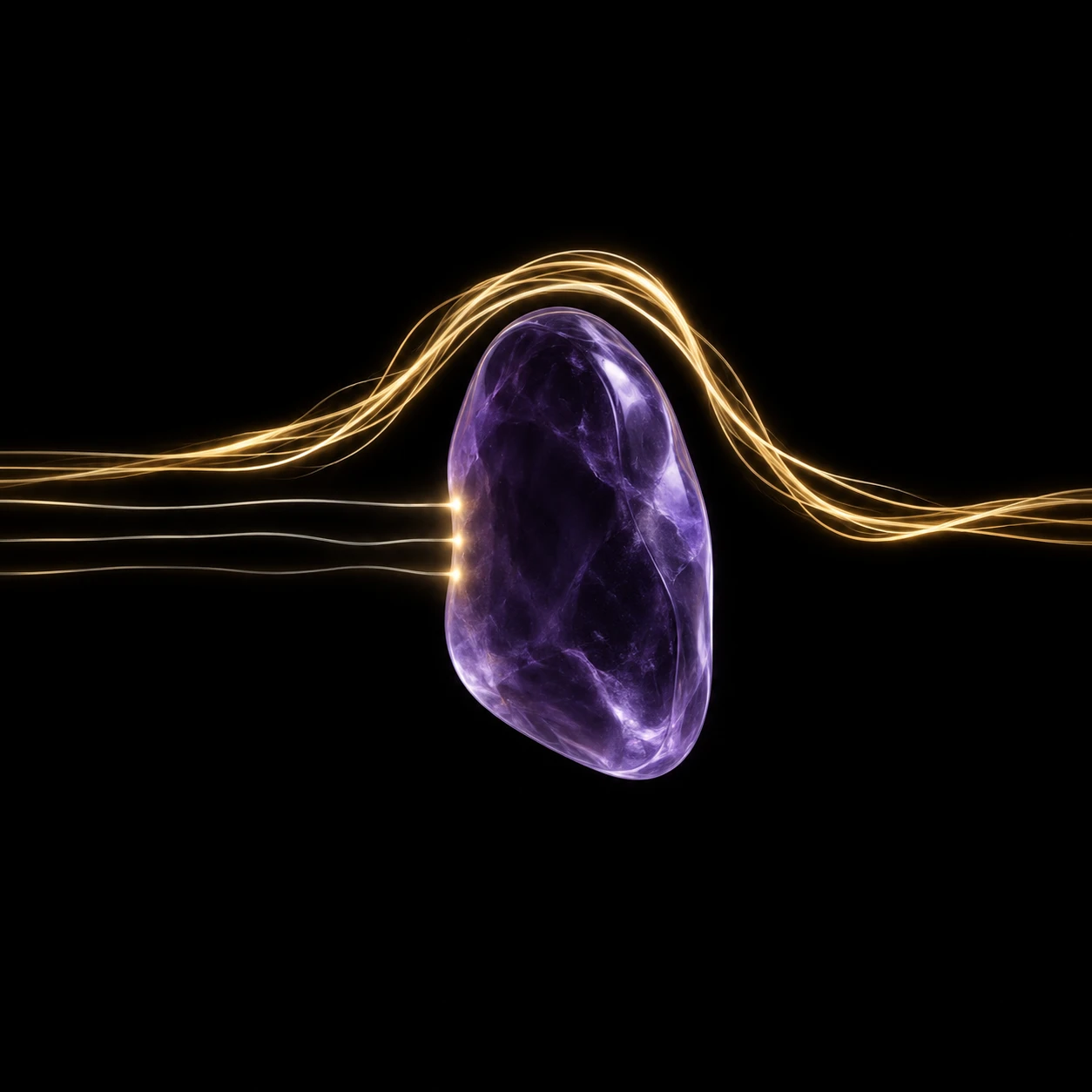
Reality can correct us because our descriptions do not control it.
When reasoning works repeatedly across demanding tests, that gives us reason to think it preserves something of the world’s structure. It is evidence of contact, rather than a guarantee that we have reached a final account.
This is also a shared achievement. Other people notice errors we miss. Language, instruments and institutions allow corrections to outlive the person who first made them.
Explore the territory: Civilisation05 / Identity
A life gathers
around “I”.

Your body is doing much more than you experience. Breathing, regulation, recognition and the preparation of movement continue without every part of the process becoming available to awareness.
Your sense of yourself gathers a selection of this activity into a particular point of view: this body, this history, these relationships, these things I might do next.
On this account, the experienced self is a model within the larger living process. It helps coordinate a life across time. It carries real knowledge, along with the omissions and distortions of the circumstances in which it formed.
The life is larger
than its account of itself.
A changing, dependent self can still be real. What we need to question is the further idea of a separate controller, complete in itself, standing behind the activity and directing it from elsewhere.
Explore the territory: Identity06 / Agency
Before the choice,
an opening.
Return to the moment before you speak. Several responses remain under consideration. Keeping them available allows you to imagine consequences, reconsider an impulse and find words you had not begun with.
The proposal is that the feeling of freedom partly expresses this unresolved space of action: there are things I might do, and what I do will make a difference.
A larger list of imagined outcomes need not mean greater freedom. What matters is whether the alternatives are reachable, meaningfully different and sensitive to your actions. Uncertainty alone gives you no control.

Possibilities remain
under consideration.
Deliberation becomes
a commitment.
The action joins
a remembered life.
The organism exercises control through this process. Its reasons, memories, attention and habits affect what happens. Describing those causes does not remove their effects.
The possible illusion concerns authorship: we may experience ourselves as an independent origin of a choice whose formation extends far beyond what we consciously see.
How far does this explain free will?
This is a proposed account of the feeling of agency, not a demonstrated necessity. Maintaining alternatives could help explain deliberation without yet explaining why it feels like anything. A person’s felt freedom can also exceed or underestimate their actual control.
Quantum descriptions may inform the physical background. They do not establish that consciousness detects a field of possibilities, chooses a quantum branch or causes wave-function collapse. This account of agency does not depend on that speculation.
07 / Consciousness
And still,
there is being here.
The words on this page. A sound somewhere nearby. The feeling of a thought arriving.

And there is the fact of seeing.
An account of bodies, prediction and selfhood may explain much about the organisation of those experiences. It does not automatically explain why any of that organisation has a felt character.
Calling consciousness a compressed model leaves a question open: why is there experience at all?
Explaining what a process does
may leave open what it is
to live through it.
This position keeps that question visible. An eventual explanation might establish an identity, disclose a deeper relation or change the terms in which the question is asked. We do not yet have to decide which outcome is possible.
Being able to describe something is also different from encountering it. A description of warmth does not warm your hand. That difference alone cannot prove that consciousness lies beyond explanation, but it helps clarify what we are asking an explanation to provide.
Explore the territory: Mind08 / The limits of the account
No view contains
the whole.
Every explanation begins with something it has not explained. We can keep following its terms, relate them to one another, accept some as starting points or return to what we encounter directly.
These are useful ways to examine the limits of a demand for explanation. They do not prove that reality has no foundation, or that further inquiry must fail.
A question drawn from Zen also belongs here: what happens if we examine the division between the observer and the observed, instead of assuming it is the final shape of reality?
That question can deepen attention to experience. Whether it resolves the philosophical problem is something to investigate. A change in how a question feels does not, on its own, settle whether its assumptions were mistaken.

The frame brings part into focus. Reality continues beyond it.
This position selects relationships, makes distinctions and leaves much outside its frame. It must remain answerable to evidence, experience and objections, including those that require changing the frame itself.